

Sadder Than The Sea
Tolkien’s Túrin, Eggers’ Nosferatu, the story of Samson and the meaning in dyscatastrophic storytelling.

This essay was originally presented as a paper at the 2026 International Medieval Congress at Leeds University. It featured as part of a session titled Reading Repetition - Catastrophes and traumas: Non-linear Temporalities as an Expressive Mode, alongside papers on the aftermath of the Burning of Flugumýri in Sturla Þorðarson’s Íslendinga Saga and trauma and intertextuality in Tolkien’s Silmarillion.
The paper explores the story of Samson, the last of the judges of the ancient Israelites, whose story you can find in Judges, and how medieval readings of this story might affect how we understand modern stories defined by horror and catastrophe, especially Tolkien’s Of Túrin Turambar and the 2024 adaptation of Nosferatu directed by Robert Eggers.
You may rightly ask ‘why are you presenting this here?’ None of these are stories from the medieval period. But each of them speak to or draw from the medieval imagination, and my window into them, and through which these stories are explored, is definitively medieval.
Last year I committed to carving this linocut print of Samson. The composition is copied (in the medieval tradition) from a scene in The Morgan Picture Bible, also known as the Crusader Bible and the Shah Abbas Bible, kept in the Morgan Library in New York City.
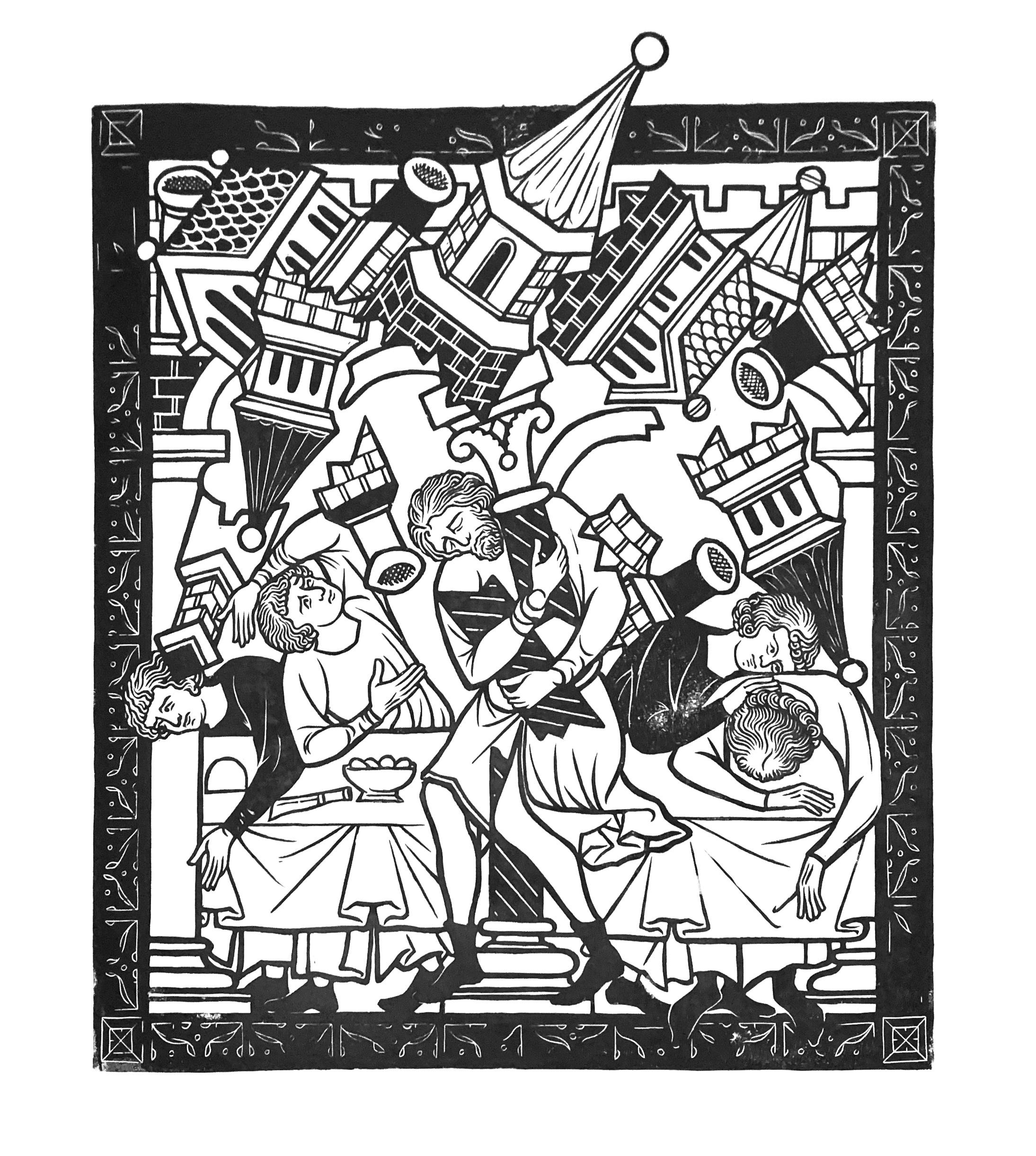
This manuscript, created in Paris between 1244 and 1254 features highly detailed miniature paintings of events from the Hebrew Bible depicted in the scenery and costumes of thirteenth-century France. The illustrations are surrounded by later text in five languages: Latin, Persian, Arabic, Judeo-Persian, and Hebrew.
Spending an extended amount of time with this image and the story surrounding it prompted reflection on the tale’s themes and patterns and their recurring resonance through time. Like the illuminators of the 13th Century, it invited thoughts of how the story reaches even into today.
It isn’t possible to adequately retell Samson’s story as told in Judges in a short paper. It includes a pre-amble about Samson’s birth, prophesied in advance by an angelic visitation and episodes from his life that detail his super-human strength, troubled relationships, the breaking of his various Nazarite vows and his struggles against the Philistines.
Samson has been, strangely, a popular story for Sunday School children. If you were told this story as a child, you perhaps remember Samson’s strength, his hair and the character of Delilah.
Samson’s story is often presented as a morality tale - a tradition that stretches back to St Ambrose of Milan (d.397), who is particularly heavy on the story as a warning against being enticed by women.1
But the story of Samson is also incredibly contested and resists being read so simply. Greti Dinkova-Bruun notes that in medieval literary discourse, reading the story of Samson as as a cautionary tale or as literal-historical was only one facet of a deeply varied and rich hermeneutic perspective, in which this relatively straightforward story was elevated to enormous cosmic and symbolic significance and very little is what it seems to be.2
Thomas O’Loughlin also writes that ‘the scriptures’ in the medieval mind were not merely a religious book for moral instruction but a “unique source of authority within the Christian inheritance … internally consistent … coherent with all other true knowledge … and capable of disclosing all that was necessary for human happiness.”3
With this in mind, we can draw our first connections with the story of Túrin Turambar, the central figure in multiple versions of a story J.R.R. Tolkien tells as part of the First Age of his legendarium.4
Samson and Túrin are both heroically strong, have troubled relationships with their family, seem to be constantly in conflict with others and ultimately die by suicide.
Both tales force readers to reckon with a protagonist who displays remarkable bravery and resilience whilst also committing appalling acts; of misogyny and mass murder in Samson’s case and accidental incest and amicide in Túrin’s.
If we were to view Túrin as a merely cautionary morality tale in how not to live our lives we might struggle to discern whether we see a victim of circumstance and of the malice of the Dark Lord Morgoth, the story’s cosmic antagonist, or whether he is in fact an antihero or a villain who damns his friends and family and causes the collapse of at least one Elven kingdom through his arrogance and stubbornness.
But beyond these tonal similarities in their character, Samson and Túrin share a connection in how their stories are interpreted beyond their time, by those who come after them.
In The Fellowship of the Ring (1954), which takes place many ages after the events of the Silmarillion, Lord Elrond lists Túrin as one of the ‘mighty elf-friends of old’, alongside more obvious heroes such as Beren and Hador.5
It may well be that this references a different version of the Túrin story that was still growing in Tolkien’s imagination when The Lord of the Rings was written.
But title seems earned in spite of the deeds of Túrin that we actually read about in The Silmarillion, which include him becoming estranged from his elvish foster-father, accidentally murdering the elf Beleg Strongbow, by some distance Túrin’s best friend, and playing a leading role in causing the fall of the elf-kingdom of Nargothrond to the dragon Glaurung.
Contrastingly, Túrin could be said to earn the title of elf-friend through his other deeds; his years spent defending the marches of Doriath and slaying aforementioned dragon, or that he receives it unconditionally through the affection of Beleg and the elven princess Finduilas.
Similarly, the writer of Hebrews in the New Testament of the Bible lists Samson as one of a long line of the faithful from the Hebrew Bible apparently in spite of his faithlessness, treatment of his family and unwitting role in the burning of his estranged wife and father-in-law.
He’s not the only apparently rogue selection in this list; Jephthah is also listed, another deeply tragic character from Judges famous for making an oath that results in him having to reluctantly sacrifice his own daughter.6
Jephthah and Samson are hard to redeem as exemplars of lives lived faithfully. Similarly, we might ask of Lord Elrond; “with elf-friends like these, who needs elf-enemies?”
This conflict exists even within Christian exegesis as early as the patristic era. Despite what the writer of Hebrews says, St Ephraim the Syrian (d. 373) lists among the contents of Hades; “the horrors: the limbs of the giants, Sampson’s huge corpse, the skeleton of cruel Goliath; there is Og, the son of the giants, too, who made a bed of iron, where he reclined.”7
St. Hippolytus of Rome (d. 235) draws a comparison between John the Baptist and Samson; John as the forerunner of Christ and Samson the antichrist. Both Samson and the prophesied Antichrist belong to the tribe of Dan.8
On online forums of Tolkien readers and readers of ancient Christian theology you will find similarly contentious and lively discussion about the legacy of these two characters.9
Another prominent theme in the lives of Túrin and Samson is the dance between fate, free will and divine providence.
Fate and free will are also at the forefront of our third story; Nosferatu, a tale set in enlightened 19th-Century Germany, where Ellen Hutter, in the loneliness of her youth, prays for a spirit of comfort to visit her from ‘any celestial sphere’. Her prayer is answered, but in the form of an ancient demon - the vampyre Nosferatu.
Like Túrin and Samson, Ellen’s choices are central to much of the story’s conflict and tension and play the vital role in the its conclusion. But as Eggers’ Nosferatu draws inexorably towards its ending, we are faced with the terrifying sense that there is only one way it can end - that perhaps there has only ever been one way it could ever end.
This tension between the protagonists’ wills and the sense of a larger hand at work (literally, in the case of Nosferatu’s most striking scene) is an essential part of all three stories.
Each story communicates this through a tremendously strong sense of foreboding at various points in the narrative.
In Judges, we are told that Samson gives his parents honey to eat from the body of a dead lion, breaking one of his vows as a Nazirite.10
After a while he returned to marry her, and he turned aside to see the carcass of the lion, and there was a swarm of bees in the body of the lion, and honey. He scraped it out into his hands, and went on, eating as he went. When he came to his father and mother, he gave some to them, and they ate it. But he did not tell them that he had taken the honey from the carcass of the lion.
His father went down to the woman, and Samson made a feast there as the young men were accustomed to do…
Every translation I’ve includes a paragraph break here. The story then abruptly continues and we are left with the feeling that this cannot possibly end well for Samson or his family.
Approaching the hill of Amon Rûdh in the West of Beleriand, we are treated to a similar narrative motif.11
Now that hill stood upon the edge of the moorlands that rose between the vales of Sirion and Narog, and high above the stony heath it reared its crown; but its steep grey head was bare, save for the red seregon that mantled the stone. And as the men of Túrin’s band drew near, the sun westering broke through the clouds, and fell upon the crown; and the seregon was all in flower. Then one among them said: ‘There is blood on the hill-top.’
But Mîm led them by secret paths up the slopes of Amon Rûdh…
In a remarkably similar style, the narrative also abruptly continues - and we are left with the sense that nothing good will occur on Amon Rûdh. Nothing will - the band is betrayed and murdered on the mountain’s summit later in the story - but not immediately. Tolkien lets the sense of foreboding stew.
In an early scene in Nosferatu we watch as the two young daughters of Friedrich and Anna, Ellen’s wealthy friends, say their bedtime prayers bathed in golden candlelight. It is notable as one of the few scenes in the film not shot in ghostly moonlight or living darkness. Again, the events of the film continue from here, but the audience is left with a strong sense that these children will not meet a happy ending.
Turambar, the name Túrin gives himself, means ‘master of fate’12 - a boast that his choices are ultimately what determine his reality. But it is a title Morgoth, the story’s primary antagonist also takes, and the story largely serves as evidence that Morgoth’s will is stronger than Túrin’s.13
It forces us to confront a question that Tolkien asks elsewhere in his writing;14
“are we not cast off finally? Is not the Nameless the Lord of the World?”
The same is true in Samson and Nosferatu, where we see even strong and resolute wills ultimately succumb to darkness. The stories themselves can seem equivocal, as might our own battles against interior and exterior darkness.
The tradition of typology within Christian exegesis seeks to interpret people, events and images from the Hebrew Bible (or Old Testament) as prefigures or signs of things fulfilled in the New Testament.
Dinkova-Brunn goes as far to say that this is “the central tenet in the medieval Latin hermeneutic engagement with the Bible … the belief that the Old Testament must be understood as a prefigural allegory for the coming of Christ and his Church.”15
Intriguingly, even a story as apparently forsaken and hopeless as Samson is not exempt from this. Both Isidore of Seville (d. 636) in Quaestiones in Vetus Testamentum and Abbott Gottfried of Admont (d. 1165) in his Fourth homily for Palm Sunday interpret Samson using Christological typologies. Isidore prefigures the events of Christ’s Incarnation with similar episodes from Samson’s life, especially the angelic visitations that herald their births.16
But Gottfried’s typologies are more varied and often apparently contradictory, drawing deep and complex connections from the whole of human history, from Eve to Christ’s Passion and comparing the character of Delilah sympathetically with the complexity of human nature.
Hildebert of Le Mans (d. 1133) in his biblical epigrams also interprets Samson with imaginative typologies - in his writing the temple of Daegon represents Christ’s broken body and the multitudes killed by Samson the many saved by Christ’s Passion.17
The fact that Samson’s death was a suicide intended to result in the reciprocal deaths of thousands of Philistines isn’t an obstacle to these reinterpretations.
One might similarly conclude that Túrin’s eventual defeat of the great dragon Glaurung, despite his subsequent suicide, is enough to redeem his story and secure his status as elf-friend. Early drafts of Tolkien’s writing include references to a resurrected Túrin, who is the one to deal Morgoth’s death blow in the Last Battle at the end of all things.18
Ellen is perhaps an even better example of a shadow-Christ in the tradition of Samson; whose story can be interpreted as a Christological typology despite the horror and apparent forsaken-ness of its content.
Ellen’s story feels markedly different from the others, and perhaps even more narratively non-linear in that cosmologically it occurs after Easter Sunday. One of the greatest discomforts watching Nosferatu, or indeed The VVitch, Egger’s masterpiece, is seeing the apparent triumph of darkness as people’s prayers go unanswered.
The steeple of Wisberg’s church or the cross are rarely out of sight in Nosferatu, but unlike Stoker’s Dracula, where the sacrament is a powerful weapon, in Nosferatu we are faced for most of the film with a largely silent God whose actions and purposes are hidden to us. The same is true of Samson and Túrin; both tales in which God (or the gods with a small ‘g’ in Túrin’s case) seem less present than in the stories surrounding them.
This is Nosferatu’s strongest link to the medieval - the entire film can be seen as a conflict between the old and new ways of seeing - between enlightened modernity and something stronger, darker and distinctly pre-modern beyond it.
The Orthodox schema nuns who help heal Ellen’s husband Thomas from a vampire attack at the start of the film know what’s going on, but the bourgeois Western Christians of Germany clearly don’t, and the main characters have to turn to an occultist played by Willem Dafoe for help. His character gives the film’s central speech;
‘We are not so enlightened as we are blinded by the gaseous light of science. I have wrestled with the Devil as Jacob wrestled the Angel in Penuel, and I tell you that if we are to tame darkness, we must first face that it exists!’
Ellen’s final sacrifice to save the world by marrying the demon and allowing him to feed on her until sunrise is horrifying and desperately sad, but typologically Christological - the cleansing, fiery light of dawn on the third day has to be one of the most familiar symbols in human history.
Like Samson, it remains an apparently contradictory and uncomfortable typology to accept. Ellen still dies. And who wants to admit that a woman having to spend an entire night in the embrace of a demonic animated corpse reminds them of God?
In his essay On Fairy Stories, J.R.R. Tolkien sets out his famous vision of eucatastrophic storytelling; narratives which hinge on the sudden, joyous, unexpected ‘turn’. The eucatastrophe might well be described as a non-linear temporality. It recurs concentrically even within Tolkien’s world, but also points beyond - to the far-off gleam of evangelium in the ‘real’ world; the Incarnation and the Resurrection of Christ; in Tolkien’s words ‘a serious and dangerous matter’.19
But Tolkien adds that the existence of the eucatastrophe does not ‘deny the existence of dyscatastrophe, of sorrow and failure: the possibility of these is necessary to the joy of deliverance’.20
In this sense all three of these stories are unflinching, deeply honest and actually helpful explorations of dyscatastrophe; of life in a deeply broken world; a journey between fragmented islands of deep meaning in a vast ocean of apparently total meaninglessness.
The longer I spent with the image from the Morgan Bible, the more I noticed that Samson doesn’t really look angry or vengeful or even triumphant in his final act. He just looks sad.
‘Sadder than the Sea’ is a line from G.K. Chesteron’s The Ballad of the White Horse, an epic poem I am also in the process of illustrating, which tells the story of Alfred the Great’s victory over the Danes at Ethandune. It’s used to describe the Danes (and their gods) and their nihilistic, pagan flavour of sadness that Chesterton prophesies the return of in the modern day.21
Their gods were sadder than the sea,
Gods of a wandering will,
Who cried for blood like beasts at night,
Sadly, from hill to hill. (Book I)
“By God and man dishonoured,
By death and life made vain,
Know ye the old barbarian,
The barbarian come again—
“When is great talk of trend and tide,
And wisdom and destiny,
Hail that undying heathen
That is sadder than the sea. (Book VIII)
Whilst carving this linocut and reading these stories it was impossible to forget that Daegon’s temple, the setting for Samson’s death is traditionally located in Gaza, where today we still recognise the continually increasing cycles of vengeful and meaningless violence found in Samson’s story.
Indeed, the modern state of Israel’s nuclear strategy is referred to as the Samson Option; a recapitulation of this story on ever more existential grounds; the threat to bring down the pillars of the world in a nuclear winter.22
Who can behold what is happening today in Gaza and still hold to some kind of ultimate meaning? These questions were perhaps not so alien to medieval readers, interpreters and illuminators, who were also familiar with cycles of death and violence and nevertheless spent considerable time reading, rereading and illustrating stories like Samson’s.
But their interaction with such texts may be alien to us. There is so much of this I would like to explore further - the Rabbinic Discourse on Samson, the themes of chastity, monasticism and sacred vows in each narrative, the symbolism of hair in each narrative, the ways in which each of the protagonists is an outsider inhabiting a kind of wilderness … there isn’t the space to do so in a coherent way here.
Hopefully, the myriad apparently contradictory images and meanings covered in this paper, drawn from Samson by figures like Isidore, Gottfried and Hildebert invite us to view within these tales, whether it is Samson, Túrin or Ellen Hutter, the full breadth of the human experience through history, to locate these temporalities within our own experience and perhaps glimpse ‘beyond hope’ a far-off gleam of redemption, recognising like many of these medieval writers that even the darkest reaches of human experience are not uncharted by the grace of God.
St. Ambrose of Milan, On The Holy Spirit, Book 2, https://www.newadvent.org/fathers/34022.htm
Greti Dinkova-Bruun, “Biblical Thematics: The Story of Samson in Medieval Literary Discourse” in The Oxford Handbook of Medieval Latin Literature, edited by Ralph Hexter and David Townsend. Oxford University Press, 2012.
Thomas O’Loughlin, “The Biblical Dimension of Early Medieval Latin Texts” in Understanding Celtic Religion: Revisiting the Pagan Past, edited by Katja Ritari and Alexandra Bergholm. University of Wales Press, 2015.
J.R.R. Tolkien, The Silmarillion (Harper Collins 2013), 235-271
J.R.R. Tolkien, The Fellowship of the Ring (The Folio Society 1990), 310
Hebrews 11:32, New Revised Standard Version Bible: Anglicized Edition, 1989 https://bible.oremus.org/?passage=Hebrews+11
St Ephraim the Syrian, Nisibene Hymns, Hymn 36, https://www.newadvent.org/fathers/3702e.htm
St Hippolytus of Rome, On Christ and Antichrist, https://www.newadvent.org/fathers/0516.htm
https://www.reddit.com/r/OrthodoxChristianity/comments/1rscb7q/is_samson_a_saint/
https://www.reddit.com/r/tolkienfans/comments/hd9txk/t%C3%BArin_an_elffriend/
Judges 14: 8-10, New Revised Standard Version Bible: Anglicized Edition, 1989, https://bible.oremus.org/?passage=Judges+14
Tolkien, Silmarillion, 241
Tolkien, Silmarillion, 259
Tolkien, Silmarillion, 233
J.R.R. Tolkien, “Athrabeth Finrod ah Andreth” in Morgoth’s Ring, edited by Christopher Tolkien, HarperCollins, 1993
Dinkova Bruun, “Biblical Thematics: The Story of Samson in Medieval Discourse”, 4
Dinkova Bruun, “Biblical Thematics: The Story of Samson in Medieval Discourse”, 5
Dinkova Bruun, “Biblical Thematics: The Story of Samson in Medieval Discourse”, 11
J.R.R. Tolkien, “Part Two: Valinor and Middle-earth before The Lord of the Rings, VI. Quenta Silmarillion”, in The Lost Road and Other Writings, edited by Christopher Tolkien, Unwin Hyman 1983, 333
J.R.R. Tolkien, Tree and Leaf, (Goerge Allen & Unwin 1964), 60-61
Tolkien, Tree and Leaf, 60
G.K. Chesterton, The Ballad of the White Horse, (Methuen, 1911), https://www.gutenberg.org/files/1719/1719-h/1719-h.htm
Seymour Hersh, The Samson Option: Israel’s Nuclear Arsenal and American Foreign Policy (Random House 1991)
I think you could add Nolan's version of The Odyssey to the line up of stories here. I still need to re-watch Nosferatu with the lens you provided (Ellen as the failed-Christ type, rather than Thomas), but I took that framework to see The Odyssey and I ended up liking the movie more than I expected. Ellen types in the vein of Samson well. I think Nolan's Odysseus types very closely alongside Jonah.
I do hope to see your illustrations of The White Horse soon!